
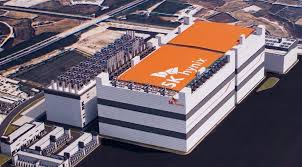
As it capitalizes on the global AI boom with one of the largest new share sales in history, South Korean chipmaker SK Hynix on Monday launched a U.S. share sale to raise 43 trillion won ($28.07 billion) and drew indications of interest for up to $7 billion from major investors.
SK Hynix stated that investment firms run by Coatue Management and Situational Awareness Partners, as well as Baillie Gifford Overseas, have independently expressed interest in purchasing up to $7 billion worth of the company’s American depositary receipts, or ADRs.
A reference price of 242,500 won per ADR, based on SK Hynix’s July 3 closing price in Seoul, was provided in a Monday filing. The business will offer 17.79 million additional shares through the ADRs on the Nasdaq; ten ADRs would represent one common share.
The transaction occurs as Asian chip manufacturers take advantage of the robust demand for AI-related stocks around the world.
Taiwan’s Unimicron Technology is also looking to raise roughly $1.4 billion by selling global depositary shares, or shares that are listed abroad and represent its local stock.
Although SK Hynix’s shares finished Monday at 2,343,000 won, down 3.4%, the stock has still increased by almost 260% this year. Monday saw a 0.5% decline in South Korea’s KOSPI.
Recent sessions have seen volatility in memory chip equities, partly because investors are once again worried about how long the boom will persist.
According to Di Zhou, portfolio manager at Thornburg Investment Management in Santa Fe, New Mexico, which has $60 billion in assets, “we are in the middle of a memory super cycle, with all three major suppliers—Samsung, SK Hynix, and Micron—riding the AI-driven demand wave.” It is the owner of Korean ordinary shares of SK Hynix.
She went on to say that SK Hynix’s ADR offering was advantageous since it would increase the company’s investor base and possibly close the value gap with Micron, a rival in the United States.
Albert Yong, a managing partner at Petra Capital Management, stated, “I would anticipate demand for SK Hynix shares to remain relatively robust despite the recent high market volatility.”
Last week, South Korea published a comprehensive industrial strategy focused on AI and semiconductors, which includes a $576 billion chip investment program in the southwest of the nation to help distribute the boom’s profits.
According to the government, the investment package will be anchored by SK Hynix and Samsung Electronics.
On Monday, South Korean President Lee Jae Myung gave officials a deadline to start working on significant chip and artificial intelligence initiatives that were unveiled last week.
He cautioned that the nation’s attempt to dominate cutting-edge industries could be jeopardized by delays in obtaining permits, acquiring land, and ensuring power and water supplies.
The world’s largest producer of memory chips is South Korea.
The world’s largest producer of DRAM memory chips, which power laptops and cellphones, is South Korea.
By revenue, Samsung Electronics is the biggest manufacturer of DRAM memory worldwide, surpassing both U.S.-based Micron and South Korean competitor SK Hynix.
INFLATION OF MEMORY
SK Hynix surpassed its main competitors, Samsung and Micron, making it one of the biggest benefactors of the AI fervor worldwide.
According to Dave Mazza, CEO of Roundhill Investments in New York, which oversees an exchange-traded fund that tracks DRAM manufacturers—one of the most common ways for US investors to trade SK Hynix’s stock—this is more than just a liquidity event.
“SK Hynix has been one of the most important companies in the world that most U.S. institutions could not easily own.
“The listing eliminates a discount for accessibility rather than quality.
The U.S. listing would help people and smaller institutions more than big investors, according to Steve Sosnick, chief strategist of Connecticut-based Interactive Brokers.
SK Hynix said the profits from the American Depositary Receipts listing will be used to construct chip facilities in South Korea and purchase chipmaking equipment, such as an ultraviolet scanner manufactured by ASML, a Dutch equipment manufacturer.
According to regulatory records, the New York listing’s final price is scheduled to be determined on Thursday, before the stock begins trading on Friday.
This week, the company’s management will go on a roadshow to meet with investors from around the world.
The transaction is anticipated to be the second-largest share sale following SpaceX’s record $85.7 billion IPO last month, which surpassed Saudi Aramco’s $25.6 billion IPO in 2019 and Alibaba’s comparable-sized offering in 2014.
Some investors were worried that memory “inflation” would reduce spending on PCs, smartphones, and AI equipment.
Sundeep Gantori, chief investment officer of stocks at Standard Chartered, stated,
“We anticipate improved access, but the timing of the memory cycle is equally important.” “We believe the memory cycle is beyond the early phase and now in the mid-cycle stage.”
Customers like Nvidia and Alphabet’s Google employ SK Hynix’s high-bandwidth memory chips in AI systems.
According to analysts, SK Hynix is anticipated to join the chip-heavy Philadelphia SE semiconductor index, opening the door for a rise in passive investments.
HSBC announced this month that it would increase the price-to-book multiple of SK Hynix by 20%, meaning a multiple of 3.4 times, “reflecting more proactive shareholder-friendly initiatives and improved accessibility to global investors.”
BofA Securities, Citigroup, Goldman Sachs, and J.P. Morgan are global coordinators for SK Hynix’s offering.