

Major tech businesses’ expectations have been reset by Alphabet’s cloud growth, prompting investors to reevaluate which companies are producing the most obvious rewards.
With combined expenditures now expected to exceed $700 billion this year, up from roughly $600 billion previously, all four of the U.S. tech titans that released results on Wednesday indicated that investment in AI would not slow down.
In premarket trading on Thursday, Alphabet shares increased by almost 6%, while Meta stock dropped by about 9%. Shares of Microsoft fell 1.8%, while those of Amazon increased 2.6%.
The responses highlight a widening gap as the largest tech firms invest unprecedented amounts in AI, with investors rewarding those that are clearly increasing revenue.
In the March quarter, cloud computing revenue increased more quickly for both Amazon and Microsoft, at 28% and 40%, respectively.
However, those were insignificant compared to Google Cloud’s greatest gain to date, a 63% increase in revenue that was significantly higher than forecasts of 50.1%.
According to CEO Sundar Pichai, Google’s AI tools for big organizations have emerged as Google Cloud’s main growth engine for the first time, supporting Alphabet’s choice to convert its extensive research resources into profitable ventures.
Indeed, Google’s cloud business is far smaller than that of Amazon and Microsoft, and it has only recently begun to make a significant contribution to Alphabet’s overall income in the last few quarters.
In addition to exceeding quarterly revenue targets, Meta cautioned about possible losses due to a worldwide reaction to children’s safety on social media, which increased pressure from its skyrocketing AI expenditures.
According to Ken Mahoney, CEO of Mahoney Asset Management, “Google is really the shining star in tech earnings so far.”
Google Acquires a New Cloud Company
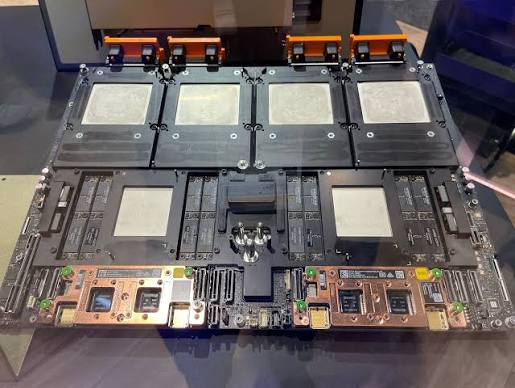
Because of its powerful custom processors and AI tools for businesses, which have drawn clients like Anthropic, analysts and investors believe Google is snatching up a significant portion of the new computer demand.
According to Pichai, Google has begun selling its AI chips—which rival Nvidia’s semiconductors—directly to some consumers.
“It is capturing new workloads for the most part—sometimes from companies new to cloud and often additional workloads from customers of other clouds who want to be less dependent on a single cloud provider or who like Google data, analytics, and AI offerings,” Lee Sustar, principal analyst at Forrester,
According to Pichai, if it weren’t for the industry-wide capacity limitations on processing power that have spurred Big Tech’s spending binge, cloud growth could have been higher.
The business increased its annual capital investment forecast by $5 billion to between $180 billion and $190 billion in order to address those shortfalls, and it stated that it planned to make another large increase in 2027.
Daniel Newman, CEO of the tech research firm Futurum Group, stated,
“The risk of sitting it out is bigger than the risk of leaning in,” in reference to the substantial AI bills.
“Every hyperscaler (large cloud company) understands that under-investing in this cycle is an extinction-level risk.”
Alphabet will get closer to Amazon, which kept to its $200 billion yearly spending target, as a result of its growing costs.
Investors who had sold their stock when the prediction was first announced in January were somewhat reassured by this.
Shareholder trust has also increased as a result of back-to-back agreements strengthening Amazon’s partnerships with OpenAI and Anthropic.
As of the most recent close, the company’s shares were up around 14% this year, making it one of the top performers in the “Magnificent Seven” group of IT mega-caps.
Forecasts from Microsoft Cloud and Outlay exceeded projections.
Microsoft reassured investors that revenue in its Azure cloud business will expand between 39% and 40% in constant currency terms in the current quarter, higher than projections for 36.7% growth, after a little growth acceleration initially pushed shares lower.
However, the anticipated increase in revenue would also result in an increase in expenditure, with a projected $190 billion capital investment for the year 2026.
Rising costs for parts like semiconductors account for about $25 billion of that expenditure.
Regarding Azure’s AI business, CFO Amy Hood stated on a post-earnings call that “wide and growing customer demand continues to exceed supply.”
Microsoft said that user engagement levels for its Copilot AI assistant were comparable to those of Outlook and highlighted the benefits for users.
However, overall Copilot adoption has been slow. Customers are going to Google because its AI is seen as more accurate and trustworthy than Copilot and because its full-stack approach is likely to drive greater economies of scale,” said Rebecca Wettemann, CEO of Valoir, an industry analyst firm, referring to Google’s focus on every layer of the AI technology chain, including chips, data centers, AI models, and developer tools.