
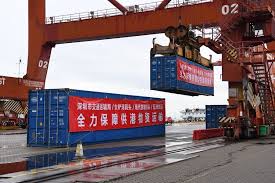
China grants the largest economies in Africa tariff-free access to its market for the next two years, thanks to a policy that went into effect on Friday.
Meanwhile, the United States, China’s economic adversary, wants to impose new import levies as part of President Donald Trump’s protectionist agenda.
The 20 biggest economies in Africa—including South Africa, Egypt, Nigeria, Algeria, and Kenya—are covered by the China agreement.
China claims that 53 of the 54 countries on the continent are now entitled to “tariff-free treatment” for their commodities because it has previously removed tariffs on 33 of the poorer African states.
Since Eswatini is the only country in Africa with official diplomatic connections to Taiwan, it is ineligible.
China claims it will promote reciprocal growth.
According to China’s State Council’s Customs Tariff Commission, the deal will further Africa’s and China’s shared development.
The first batch of products to enter under the new zero-tariff policy, according to China’s official Xinhua News Agency, was a cargo of 24 metric tons of apples from South Africa that cleared customs in Shenzhen early on Friday.
According to Xinhua, China’s Commerce Ministry stated that it will particularly help African goods that were previously subject to tariffs ranging from 8% to 30%, such as cocoa from Ghana and the Ivory Coast, coffee and avocados from Kenya, and citrus fruits and wine from South Africa.
More than half of the world’s supply of cocoa comes from Ghana and the Ivory Coast, which is by far the largest producer in the world. A significant exporter of citrus fruits is South Africa.
African countries are turning away from the United States.
Following the Trump administration’s imposition of reciprocal tariffs a year ago, which at one point had rates of 30% for South Africa, the continent’s largest economy, and higher than 40% for some other African nations, several of Africa’s leading economies announced they would search for new markets for some of their U.S.-bound goods.
During bilateral talks in China in February, South African Trade Minister Parks Tau stated, “South Africa looks forward to working with China in a friendly, pragmatic, and flexible manner.”
Trump’s expansive international tariffs were declared unlawful by the U.S. Supreme Court in February, but the Republican president quickly implemented temporary import taxes in their place, claiming his government had “very powerful alternatives.”
Africa, which has 1.5 billion people and is predicted by the UN to nearly double to 2.5 billion by 2050, when it would have more than a quarter of the world’s population, already has China as its largest trading partner.
China has a significant trade imbalance with Africa.
Although there is a significant trade deficit between China and Africa, and African countries owe Beijing billions in debt repayments, China praised its tariff-free agreement as fostering shared prosperity.
In 2025, commerce between China and Africa reached a record $348 billion. However, China’s exports to Africa climbed by almost 25% to $225 billion, while its purchases from Africa increased by just about 5% to $123 billion, increasing Africa’s trade deficit.
For a long time, China has shipped produced items back to Africa after importing raw materials.
The majority of African raw material exports, such as oil and minerals, already had tariff-free access to China, according to Thierry Pairault, a China-Africa specialist at France’s National Center for Scientific Research, although the new policy might have some advantages for agricultural products.
Xi Jinping, the Chinese leader, is presenting China as the opposite of protectionism in the West.
In an evaluation released by the China Global South Project, which examines China’s interactions with developing nations, Pairault stated, “This gesture is intended to appeal to both African public opinion and global markets.”