
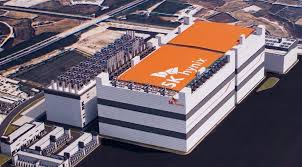
On Wednesday, SK Hynix joined memory chip competitors Samsung Electronics and Micron Technology in surpassing $1 trillion in market value on an AI-driven rise.
As shares of SK Hynix ended the day up 9.3% after rising as much as 14.9% during the session, the South Korean chipmaker’s market capitalization reached a record 1,680 trillion won ($1.12 trillion), and the nation’s benchmark KOSPI index reached a record high.
On May 6, domestic competitor Samsung topped $1 trillion in market value for the first time, and on Tuesday, U.S.-listed Micron did the same.
The world’s largest semiconductor manufacturers have benefited from the restricted supply and increased pricing caused by the strong demand for high-end memory chips used in AI chipsets like those made by Nvidia.
Due to AI data center demand, which has limited supplies for smartphones, laptops, and cars, and helped top memory chipmakers report record profits, memory chip prices doubled in the first quarter alone compared to the previous period and are expected to rise by up to 63% in the current quarter.
Only three Asian businesses, including TSMC, have reached the $1 trillion club. South Korea has become the first country other than the U.S. to have more than one company reach that market value.
GOALS FOR HIGH VALUATION
After surging as much as 5.1% to an all-time high of 8,457.09, South Korea’s KOSPI stock index, led by the two chipmakers, gained 2.3% at 8,229.70.
The significant increases caused a “sidecar” block that momentarily stopped algorithmic trading.
Samsung and SK Hynix made up half of the index by market capitalization following Wednesday’s surge. After soaring 76% last year, the KOSPI, which has become the world’s top performer in a worldwide AI boom, has increased 95% so far this year.
Kim Young-gun, an analyst at Mirae Asset Securities in Seoul, stated in a report that “we expect memory chip demand to continue exceeding supply by 2028 to keep price levels high,” increasing the target prices for SK Hynix and Samsung by 18.8% and 14.6%, respectively, to 3.8 million won and 550,000 won per share.
On Wednesday, SK Hynix’s stock closed at 2.243 million won.
As unionized workers in South Korea voted to approve a tentative wage contract, avoiding a walkout that endangered global chip supplies, Samsung shares also saw an 8% increase before finishing 2.7% higher at a record close of 307,000 won.
In a research released on Tuesday, UBS stated that it has more than tripled its target price for Micron, noting “the structural changes AI has driven to the entire memory complex.”
So far this year, shares of Samsung have increased 149%, shares of SK Hynix have gone up 215%, and shares of Micron have increased 245%.
Interest in ETFs
A new exchange-traded fund (ETF) that exposes U.S. retail investors to Samsung and SK Hynix has received billions of dollars in recent weeks.
As semiconductor shares jumped on Wednesday, the first South Korean single-stock leveraged ETFs associated with Samsung and SK Hynix saw double-digit gains.
The KOSPI reduced gains close to the session close following the ETF effect, according to Kang Jin-hyuk, an analyst at Shinhan Securities in Seoul.
“Leveraged ETF buying leads to futures buying, raising futures prices and the gap…with spot prices also boosting spot purchases.”
Financial investment firms were net buyers of KOSPI shares valued at 1.3 trillion won, thanks to massive public purchases of leveraged ETFs.
Although international investors were net sellers, retail investors also purchased 403 billion won.
As investors rushed to access the courses, the Korea Financial Investment Association’s website, which offers online courses necessary for retail investors to invest in leveraged ETFs, was momentarily unavailable on Wednesday, according to local media.
Just 75 of the 918 regular shares that were traded on the benchmark index saw an increase, while 826 saw a decrease.