
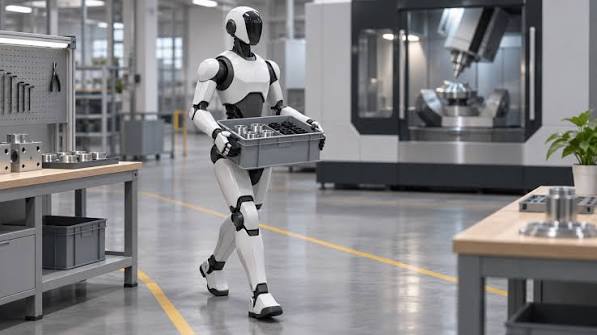
J.P. Morgan said Thursday that US humanoid robot output could reach 300,000 to 400,000 units by 2030 and roughly 1.5 million by 2035, as the sector moves beyond demos and into real-world commercial use.
Worker shortages, better economics, and expanding manufacturing capacity are driving uptake in factories, logistics, and warehouses, where companies want to automate repetitive work.”
J.P. Morgan said the Trump administration’s conclusion that imported robotics and industrial machinery threaten national security could lead to tariffs or other steps to strengthen domestic production.
Buy COMPLETE GLOBAL TRADE MASTERY @ https://selar.com/p/51175y15ag?affiliate=t3ke
Hardware, AI training data, computing power, and manufacturing capacity are holding back humanoid deployment. Most US makers other than Tesla are aiming for 10,000 to 30,000 units a year.
The bank estimates humanoid costs are close to matching labor costs, and running robots across multiple shifts could save each customer roughly $100,000 a year.
The bank added that near-term progress is limited by supply, with the main chokepoints being hands, actuators, the AI “brain,” and production capacity.
Buy E-COMMERCE BUILDER BUNDLE @ https://selar.com/p/r78po4856y?affiliate=3bl5
J.P. Morgan said suppliers of components offer the best near-term opportunity, and it expects the market for key parts such as actuators, motors, and vision systems to approach $30 billion by 2035.
Among US humanoid makers, the bank names Tesla’s Optimus, Agility Robotics’ Digit, Boston Dynamics’ Atlas, Figure AI’s Figure robots, and Apptronik’s Apollo as the main players.
It prefers component makers, including Timken, Robotis, Leader Drive, Orbbec, and Cognex.
Over time, the bank expects value to move toward robot manufacturers and platform integrators.
Buy CHINA IMPORTATION MASTERCLASS @ https://selar.com/p/9c5884f481?affiliate=98wu