
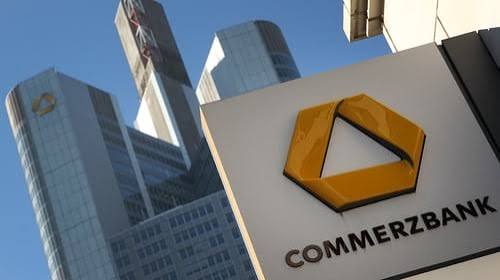
Following better-than-expected quarterly results on Thursday, Germany’s Commerzbank announced that it has started negotiations with UniCredit on a potential purchase by the Italian lender, saying that a joint approach by the banks can produce value.
Significant progress has been made in the two-year struggle for control of Germany’s second-largest bank by its Italian rival with the public declaration of a resumption of negotiations and a more accommodative tone.
In recent weeks, the story has drastically changed, with UniCredit gaining ground as Commerzbank executives hinted that negotiations would soon pick back up following UniCredit’s hostile acquisition bid for €45 billion ($52 billion).
“DETERMINED TO CREATE VALUE”
Commerzbank CEO Bettina Orlopp told analysts, “We have started talks on this, which is in the genuine interest of both UniCredit and Commerzbank, as we are both determined to create value for our shareholders, clients, and employees.
“I’m hopeful that we can gradually come to an agreement on both the business model and governance.”
A partnership with UniCredit has long been resisted by Orlopp and her management group. There have been multiple rounds of discussions, but they have all resulted in disagreement.
A request for clarification on Orlopp’s comments was not immediately answered by UniCredit, and it was unclear whether the most recent discussions were formal negotiations.
Orlopp went on to say that it was best for both banks to proceed as soon as possible and that they would look for ways to cut costs and see if they could work together on significant investment projects.
As the Italian bank approaches control, having acquired a 48% share in its target, Commerzbank’s presentation on Thursday also demonstrated its growing willingness to collaborate with UniCredit on a potential transaction.
Orlopp stated that rather than acting unilaterally on any structural changes, UniCredit, despite its significant interest, must collaborate with her management team on a future course.
After the German lender reported a 94% increase in second-quarter net profit, aided by higher commission income, she stated, “It requires a shared understanding of the business model and the involvement of all stakeholders.”
In a long-planned investor call on Thursday, the management of both banks had the chance to share their perspectives.
Commerzbank posted a second-quarter net profit of €898 million, exceeding analyst forecasts of €845 million in a consensus prediction released by the bank and up from €462 million a year earlier.
Prior to the results announcement, a person familiar with UniCredit’s thinking stated that the Italian bidder was keeping an eye out to see if Commerzbank would change its focus from foreign lending and trading to Germany, revealing a divergence in strategy.
According to Commerzbank, its global network is essential to its approach.
Andrea Orcel, the CEO of UniCredit, recently stated that he preferred to negotiate with the German government and Commerzbank staff rather than the management of the German lender.
Through a spokeswoman, the German Finance Ministry, which is in charge of a 12% stake that the government has maintained since Commerzbank’s rescue during the global financial crisis, criticized UniCredit’s “aggressive approach” and stated that it was up to the two banks to decide how to move forward.
Widespread German resistance to Orcel’s advances highlights how challenging it is to combine huge banks from different eurozone nations in order to help them compete with more powerful U.S. rivals.