
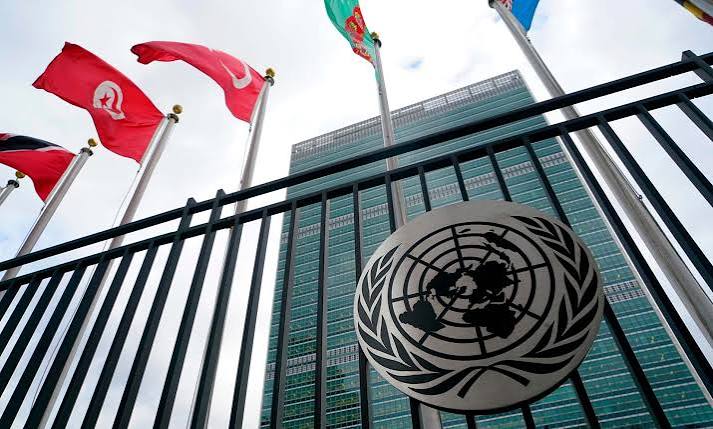
The Trump administration has notified Congress of its plan to pay $725 million to the United Nations.
Aid experts hailed this action as a positive step toward settling billions of dollars in outstanding debts.
The administration has reduced funding to numerous U.N. organizations and blamed the international organization for not reaching its full potential.
When questioned about the anticipated payment, a U.S. official stated that any payments would be subject to the organization’s ongoing reforms and that as of Friday, the U.S. has not transferred any money.
The funding allotment is in advance of U.S. President Donald Trump’s anticipated speech to the U.N. General Assembly in New York next month.
It was noted in an unreported State Department notification letter to Congress on August 4.
“IT MAINTAINS THE SHIP A LITTLE LONGER.”
This year, U.N. Secretary-General Antonio Guterres declared that the organization faced “imminent financial collapse” as a result of member states’ unpaid contributions, and the international organization has implemented significant budget cuts.
A State Department official stated, “Over the past six months, the United States has achieved historic reforms across the U.N. – reforms long considered impossible – including the first real budget cut in U.N. history, resulting in nearly one billion in cuts.”
Devex, a development news agency, revealed in April that the United States had stipulated certain requirements for the disbursement of funding, including additional cost-cutting measures and actions to resist China’s influence.
In an attempt to fund initiatives that are in line with the interests of American taxpayers, the Trump administration has drastically reduced both domestic and foreign funding and carried out an unprecedented shrinkage of the federal government, claiming it was bloated.
Although Washington has claimed that the entire amount is significantly smaller and that it has made some payments, the $725 million would be less than 20% of the more than $4 billion that the United Nations claimed the United States owed in May.
According to former U.N. official Eugene Chen, such a transfer might not be sufficient to cover all U.N. salaries, but it would help for a while. “It keeps the ship afloat a little longer,” he replied.
“If the U.S. does not make further payments, it will likely lose its voting rights in January,” he stated.
A member state loses its ability to vote in the General Assembly under Article 19 of the U.N. Charter if its yearly fee arrears exceed two years; however, there may be grace periods.
According to Ronny Patz, a U.N. finance specialist with the German research tank IDOS, a sizable transfer now might prevent the need for urgent spending cuts.
“If they pay a big chunk, the U.N. still runs on zero reserves, but it gets through the year,” Patz said.
“In terms of paying salaries and keeping the doors open, the U.N. might really be in trouble for the last two or three months of the year if they don’t pay.”
The largest donor to the U.N. budget is the United States, but under the Trump administration, it has cut voluntary financing to U.N. organizations with their own budgets and refused to make required payments to regular and peacekeeping budgets.
Additionally, Washington has pulled out of other international organizations, including the United Nations.
According to Controller Chandramouli Ramanathan last month, the U.N. had anticipated receiving almost 90% of dues from its 193 members for this year’s budget.
According to a U.N. document, 129 members had made full payments as of August 18. The ranking did not include China, the second-largest contributor behind Washington.
In a letter dated August 4, the State Department stated that it was obligating $725 million for the normal budget of the United Nations.
The United Nations said in May that Washington owed it more than $4 billion, comprising $2.04 billion for the annual budget, $2.2 billion for ongoing and past peacekeeping operations, and $44 million for U.N. tribunals.
About $153.4 million in “policy-based withholdings” has not been transferred by Washington.
This included monies for the U.N. Palestinian Refugee Agency and $10.6 million intended for the Human Rights Council, which Washington withdrew from last year due to alleged anti-Israel bias.
In the midst of its financial crisis, the 80-year-old organization has been going through a reform and cost-cutting initiative called “UN80”.
It has already moved more than 2,000 staff from pricey places like Geneva and New York to less expensive hubs and reduced its 2026 budget by 9.2%.