

Amazon announced that it will increase its capital expenditures on technology, primarily artificial intelligence, by an extra 10% this year.
The tech and e-commerce giant reported strong profits and net sales for the second quarter of its fiscal year, which were aided by the rapid expansion of its well-known cloud computing division.
The Seattle-based business announced on Thursday that sales in its cloud computing division, AWS, increased by 37% between April and June. This is the greatest growth rate in 18 quarters, surpassing the 28% clip in the prior quarter.
During the call, CEO and President Andy Jassy told investors that Amazon now anticipates $220 billion in capital expenditures, including expenditures on robots, semiconductors, and satellites.
That is significantly more than the $128 billion in capital expenditures for the entire previous year and an increase from the $200 billion investment plan that was unveiled in February. Jassy stated that the primary cause of the rise was the increased price of memory chips.
Even at the $220 billion level, Jassy warned investors, Amazon won’t have the capacity to handle all of this year’s demand.
He continued, “I think this dynamic will also be true in 2027, too.” “The demand we already have for 2028 is really impressive.” Nevertheless, after-hours trading saw a greater than 9% increase in shares.
Investors had been keeping a tight eye on Amazon’s quarterly results to see if the company’s significant investments in artificial intelligence were beginning to pay off.
The Seattle-based business provided a conservative sales forecast for the current quarter.
Among the internet giants, Amazon was one of the last to release its earnings for the most recent three months. Investors can study the industry’s rise in cloud computing and AI spending.
Last week, Alphabet, the parent company of Google, announced better-than-expected revenue for the second quarter, driven by an 82% growth in its cloud division.
However, the IT giant raised its full-year capital expenditure forecast to a range of $195 billion to $205 billion, which caused the stock to plummet. This represents an increase from its prior forecast of $180 billion to $190 billion.
Growth for its Azure cloud business was robust, according to Microsoft, which on Wednesday announced higher profit for the most recent quarter than analysts had anticipated.
The amount of money the corporation intends to invest in AI has not significantly increased. Shares increased as a result.
Investors are concerned that such expenditures are depleting businesses’ cash flows and could not be worthwhile in the long run if AI doesn’t produce the promised levels of productivity and earnings.
AWS is “booming,” according to a statement issued on Thursday by Jassy, who also mentioned that the company’s chips and AI divisions have surpassed run rates of over $25 billion.
He pointed out that during the first half of the year, the company set records for Prime members’ in-store delivery speeds, with 40% more items being delivered same-day or overnight.
He stated, “There’s a lot to be excited about, and we have much more coming for customers in the second half of the year and beyond.”
The demand for Amazon’s services and technologies continues to rise, as seen by the company’s most recent quarter results.
Amazon signed significant agreements with OpenAI, Anthropic, and Meta in April.
One day after the artificial intelligence startup announced it was severing ties with longstanding supporter Microsoft, Amazon announced in April what it dubbed a “major expansion” of its cooperation with ChatGPT manufacturer OpenAI.
However, due to President Donald Trump’s international trade policies, Amazon, like other businesses, is facing increased tariff expenses. The company’s e-commerce sales may also be impacted by rising shipping costs due to the Iran War’s impact on fuel and oil prices.
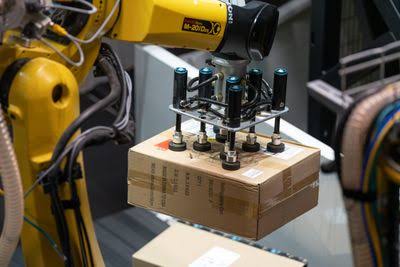
In the meantime, Amazon has been deploying robotics, artificial intelligence, and more effective warehouses to expedite order delivery times.
Fortune produces a rating of the top 500 U.S. firms by total revenue for their individual fiscal years, showing that Amazon actually overtook Walmart as the country’s largest company by revenue in February due to faster delivery.
To serve customers who can’t or won’t wait for cough medicine to relieve flu symptoms or tomatoes for tonight’s supper salad, Amazon announced in May that it was quickly creating tiny order processing hubs in dozens of U.S. and international cities for 30-minute delivery.
The business reported on Thursday that same-day prescription delivery had increased by almost five times during the first half of the year, and it had more than doubled the number of new clients for its online pharmacy service.
Additionally, Amazon moved Prime Day, its major four-day sale, from July to June this year.
For the three months that ended on June 30, Amazon reported net income of $62.65 billion, or $5.75 per share. This contrasts with $18.16 billion, or $1.68 per share, during the same period last year.
Net sales increased from $167.7 billion to $200.6 billion in the previous year.
For the most recent quarter, analysts predicted sales of $197.03 billion.
Amazon stated that it anticipates net revenues between $197 billion and $202 billion. FactSet reports that analysts anticipate $203.9 billion.