

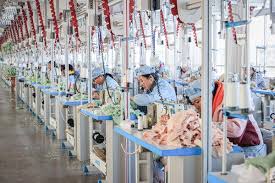
The chief of the International Monetary Fund has called on China to correct its economic imbalances, claiming that the 1.4 billion-person nation cannot thrive solely through exports.
Following President Donald Trump’s increase in import levies from China and numerous other nations, China’s exports to other countries have been increasing while shipments to the US have decreased.
Beijing announced earlier this week that its 2025 trade surplus had already surpassed a record $1 trillion.
The significant reliance on exports, according to IMF Managing Director Kristalina Georgieva, might lead to further actions by its trading partners to restrict imports from China.
At a news conference on Wednesday, Georgieva stated, “China’s continued reliance on export-led growth risks furthering global trade tensions.”
“China has a sizable domestic market that can be a major aspiration for growth in the years to come, and it is now too big to rely on exports as a source of growth.”
China’s leaders emphasized the need to increase domestic consumption at a high-level meeting in October to create plans for the next five years.
The ruling Communist Party has long worked to restructure the economy away from excessive reliance on infrastructure spending as well as exports.
However, a protracted decline in the real estate market and the COVID-19 epidemic intervened, slowing activities for that once potent development engine.
Beijing, meanwhile, has worked hard to increase production in high-tech sectors while finding it difficult to control overcapacity in some sectors, including automotive manufacturing.
According to a recent Morgan Stanley prediction, China’s advanced manufacturing and high-growth industries like robotics, electric vehicles, and batteries could propel its market share in global exports from roughly 15% to 16.5% by 2030.
Georgieva was in Beijing for a yearly economic gathering with leaders of important international organizations. The IMF was also wrapping up its yearly assessment of China.
The yuan’s decline in value relative to the dollar and other currencies is a result of China’s declining domestic demand and consumption. As a result, China’s exports are now less expensive than those of other nations, exacerbating trade disparities.
According to the IMF, comprehensive policies are required to motivate Chinese consumers to increase their spending.
China’s market is enormous and continues to develop at a rate of around 5% per year, but domestic demand has declined as a result of people cutting down on spending as a result of job and income losses during and following the pandemic.
Household wealth has also been negatively impacted by the protracted real estate crisis, which has reduced consumer spending appetites and decreased demand for imports, exacerbating the trade imbalance.
China is selling more in other nations in Africa, Latin America, Southeast Asia, and Europe, which helps counteract the drop in exports to the United States. Due to China’s imports not keeping up, its trading partners have complained.
The EU Chamber of Commerce in China said on Wednesday that concerns are being raised by its significant trade surplus.
The IMF’s views came after Chinese Premier Li Qiang said that higher tariffs have “dealt a severe blow” to the world economy on Tuesday in front of an international group of financial experts.